When consultants work to reduce an overstated home value for property tax purposes, they do not rely on guesswork or general frustration with a tax bill. They rely on evidence. The strongest cases are usually built on documentation that shows the county’s value is either too high, applied inconsistently, or based on incomplete property information.
Here are nine common evidence types consultants use when building a stronger appeal.
1. Recent Comparable Sales
Comparable sales are often one of the first places consultants start. If similar homes sold for less than the county’s estimate of your property’s value, those sales may help show the assessment is too high.
The key is choosing homes that are truly comparable in terms of location, size, age, condition, lot characteristics, and overall appeal. A few strong comparables are often more persuasive than a long list of weak ones.
2. Comparable Assessment Data
In an equity-based appeal, consultants often compare your home’s assessment to the assessments of similar nearby homes. If homes that are similar to yours are assessed materially lower, that may support an argument that your property is not being treated uniformly.
This is especially important when market sales alone do not fully explain why your assessment is higher than comparable properties.
3. County Property Record Errors
A surprising number of appeals begin with basic factual errors in the county record. If the assessor’s file overstates your square footage, lists features that do not exist, misstates a finished basement, or assigns the wrong quality or condition rating, the value conclusion may be inflated from the start.
Consultants review these records closely because even small errors can affect the final assessment.
4. Photographs of Condition Issues
Photos can provide useful support when a home has physical issues that may not appear in public records. For example, a consultant may document:
- Deferred maintenance
- Outdated interiors
- Water damage
- Structural concerns
- Functional obsolescence
- Site-related limitations
This kind of evidence helps explain why a property may deserve a lower value than a cleaner or more updated comparable home.
5. Private Appraisals
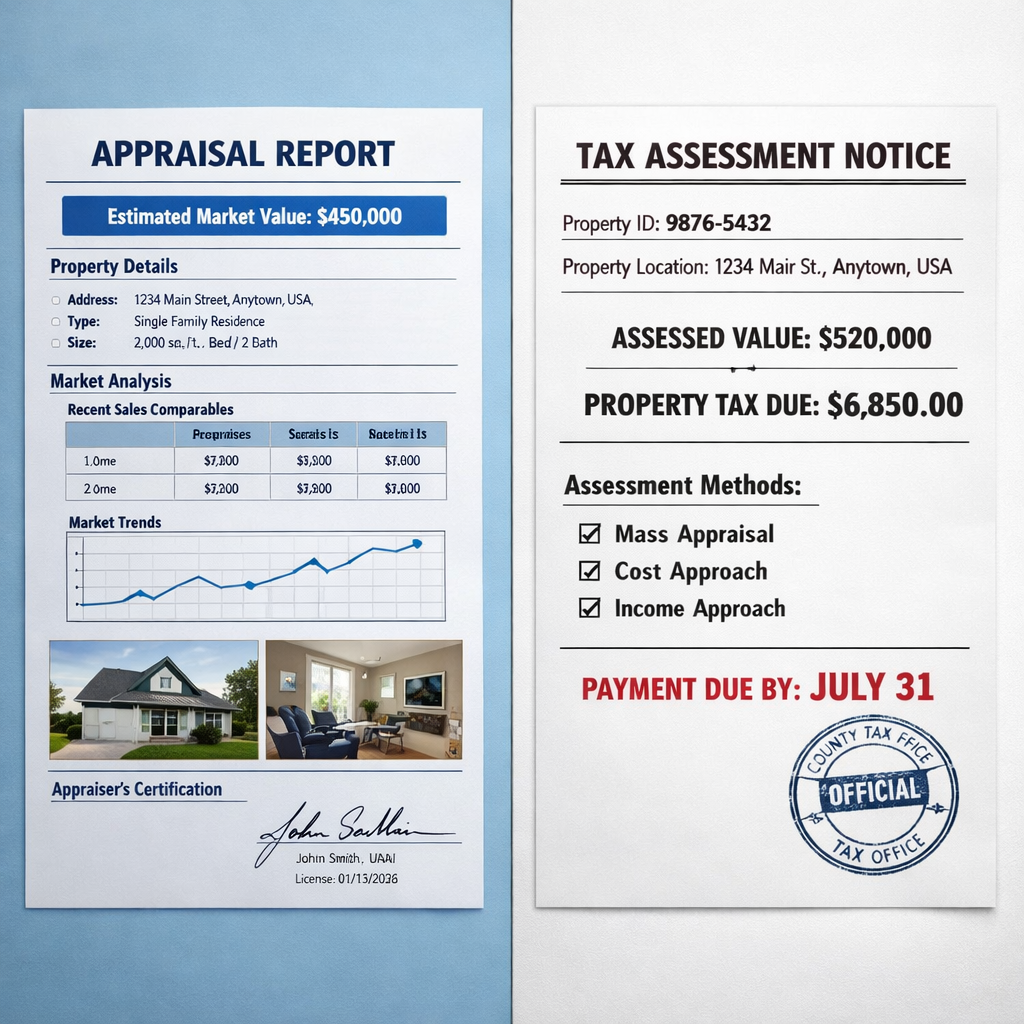
A private appraisal does not automatically control a tax assessment, but it can still be valuable evidence in the right case. If it is timely, well-supported, and relevant to the assessment year, it may help support a lower value conclusion.
Consultants typically look at whether the appraisal’s valuation date, comparable sales, and reasoning align with the appeal argument being made.
6. Market Trend Data
Sometimes the issue is not just one property, but broader market movement. Consultants may use neighborhood or local market trend data to show that appreciation has slowed, softened, or failed to support the level of increase reflected in the assessment.
Trend data can be especially helpful when the county’s valuation appears disconnected from actual market direction.
7. Side-by-Side Comparison Charts
Well-organized evidence often carries more weight than raw data alone. Consultants frequently build side-by-side charts showing how your home compares with competing properties on points such as:
- Address
- Assessed value
- Square footage
- Year built
- Lot size
- Condition
- Key features
- Sale price, if applicable
This format helps decision-makers understand the case quickly and see where the county’s value may be out of line.
8. Location-Specific Drawbacks
Not every home in a neighborhood benefits equally from its location. Consultants may gather evidence showing that a property suffers from disadvantages that reduce value, such as:
- Busy road exposure
- Proximity to commercial uses
- Poor topography
- Limited privacy
- Easement impacts
- Traffic noise or other external influences
If comparable homes enjoy a superior setting, that difference may matter in an appeal.
9. Repair Estimates or Contractor Documentation
When a property needs significant work, repair estimates can help support a lower value position. Written contractor estimates, inspection findings, or documented renovation costs may help show that the home would not compete at the same level as more updated properties.
This type of evidence can be especially useful when visible condition problems are substantial enough to affect buyer behavior and market value.
Why Evidence Quality Matters More Than Quantity
In most cases, the goal is not to overwhelm the assessor with paperwork. The goal is to present the right evidence, in a clear format, tied to a specific argument. A smaller set of strong, relevant documentation is often more effective than a large collection of loosely related materials.
For Georgia homeowners, that means focusing on evidence that is factual, comparable, and easy to explain. The best appeal files usually tell a consistent story: the county’s value is too high, the supporting facts are incomplete or uneven, and the evidence points to a lower, more defensible conclusion.