
Property condition plays a major role in Cobb County tax assessments because the overall condition of a home may directly influence its estimated fair market value.
Many homeowners focus mainly on neighborhood sales or market trends when reviewing assessments, but the actual condition of the property may also significantly affect what buyers are willing to pay. If condition issues are not properly reflected in the assessment, homeowners may potentially face inflated property values and higher property taxes.
Understanding how property condition affects assessments may help homeowners better review assessment notices and determine whether a property tax appeal may be appropriate.
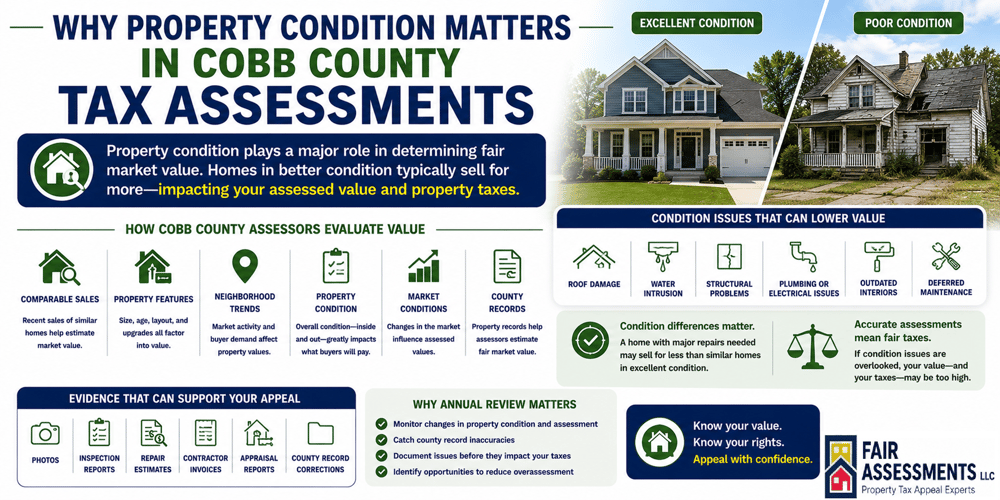
Why Property Condition Matters
Property tax assessments are generally based on estimated fair market value.
Homes in excellent condition may often sell for more than homes with significant repair needs. As a result, assessors may consider property condition when estimating value.
Property condition may potentially affect:
- Fair market value
- Assessed value
- Taxable value
- Annual property tax obligations
What Types of Condition Issues May Affect Value?
Several types of property condition concerns may influence market value.
Examples may include:
- Roof damage
- Water intrusion
- Structural concerns
- Foundation issues
- HVAC problems
- Outdated interiors
- Deferred maintenance
- Plumbing or electrical problems
These issues may reduce what buyers would realistically pay for the property.
How Cobb County Estimates Property Value
Cobb County assessors commonly consider factors such as:
- Comparable sales
- Property size
- Neighborhood trends
- Home features and upgrades
- Market activity
- Property condition
These factors help estimate what the property would likely sell for under current market conditions.
Why Comparable Sales Matter
Comparable sales, often called “comps,” are commonly one of the most important parts of property valuation.
Strong comparable properties are usually:
- Recently sold
- Located nearby
- Similar in size and layout
- Similar in condition
- Similar in age and features
Condition differences may significantly affect whether a comparable sale is truly accurate.
How Condition Differences Affect Comparisons
Two homes in the same neighborhood may still differ greatly in value based on condition.
For example:
- A fully renovated home may sell for significantly more
- A home needing major repairs may sell for less
- Outdated interiors may reduce buyer demand
- Structural issues may lower market value
If the county compares a property with condition problems to fully updated homes, the assessment may potentially appear too high.
Why Deferred Maintenance Matters
Deferred maintenance refers to repairs or upkeep that have been delayed over time.
Examples may include:
- Aging roofs
- Peeling paint
- Damaged flooring
- Exterior deterioration
- Worn systems
These issues may lower overall market value and affect what buyers may realistically offer for the property.
Can County Records Miss Condition Problems?
Yes.
County records may not always reflect:
- Interior damage
- Water intrusion
- Structural concerns
- Aging systems
- Cosmetic deterioration
- Deferred maintenance issues
If these problems are not documented properly, the county may estimate a higher value than the property would realistically sell for.
What Evidence May Help Document Property Condition?
If homeowners believe condition issues were overlooked, useful evidence may include:
- Property photos
- Inspection reports
- Contractor estimates
- Repair invoices
- Appraisals
- Engineering reports
Strong documentation may help support a more accurate valuation argument.
Why Repair Estimates Matter
Repair estimates may help demonstrate how property condition affects market value.
Examples may include estimates for:
- Roof replacement
- Foundation repairs
- HVAC replacement
- Water damage restoration
- Plumbing repairs
- Structural repairs
These costs may influence what buyers would realistically pay for the property.
Why Annual Assessment Reviews Matter
Property condition and market conditions may change over time.
Annual review may help homeowners:
- Monitor assessment increases
- Document worsening condition issues
- Catch county record inaccuracies
- Evaluate future appeal opportunities
Regular review may help reduce long-term overassessment risks.
Common Mistakes Homeowners Make
Some homeowners weaken their appeals by:
- Failing to document condition issues
- Using weak comparable sales
- Ignoring county record errors
- Waiting too long to gather evidence
- Assuming assessors already know about interior problems
Clear and organized evidence may strengthen the overall appeal process.
Can Property Condition Support a Tax Appeal?
Yes.
If homeowners believe property condition was not properly reflected in the county’s assessment, they may have the right to file a property tax appeal.
Supporting evidence may help demonstrate that the estimated fair market value appears too high based on the property’s actual condition.
Why Professional Guidance May Help
Property condition analysis and assessment review can sometimes become complicated.
Professional guidance may help homeowners:
- Analyze comparable sales
- Evaluate condition adjustments
- Review assessment accuracy
- Organize supporting evidence
- Prepare stronger appeal support
This may improve the effectiveness of a property tax appeal.
Final Thoughts
Property condition can significantly affect Cobb County tax assessments because buyers often consider a home’s condition when determining market value.
By reviewing assessments carefully, documenting condition concerns thoroughly, and comparing the property against accurate comparable sales, homeowners may improve their ability to identify inaccurate valuations and potentially reduce unnecessary property tax costs.