
Filing a property tax appeal in Gwinnett County may help homeowners challenge an assessment they believe is too high. However, before submitting an appeal, it is important to carefully review the property assessment and gather accurate supporting information.
Understanding what to review before filing may help homeowners prepare stronger evidence, avoid common mistakes, and better evaluate whether an appeal may be appropriate.
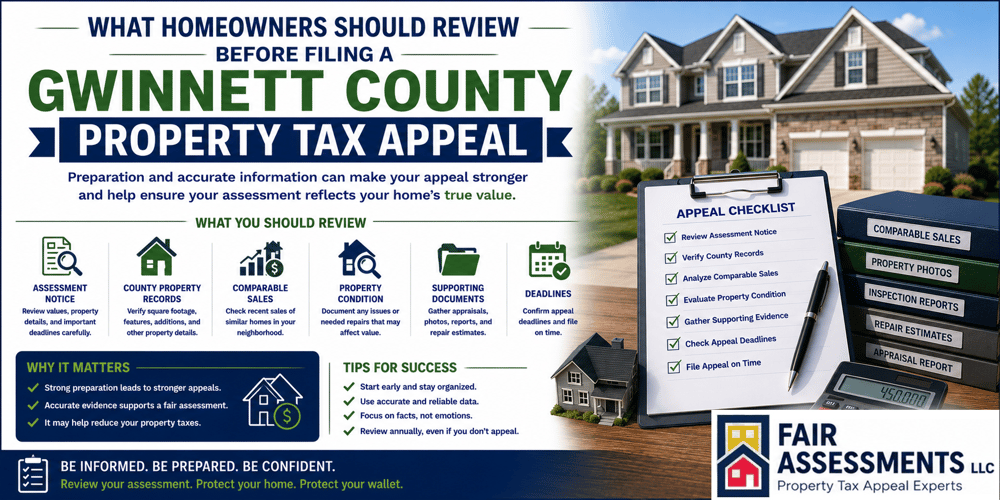
Why Preparation Matters Before Filing an Appeal
Property tax appeals are generally based on whether the county’s estimated value accurately reflects fair market value.
Strong preparation may help homeowners:
- Identify possible assessment errors
- Gather stronger supporting evidence
- Review comparable sales accurately
- Improve organization during the appeal process
Well-prepared appeals are often more effective than appeals based only on frustration about taxes.
Review the Assessment Notice Carefully
The first step is reviewing the county assessment notice thoroughly.
Important information may include:
- Fair market value
- Assessed value
- Taxable value
- Prior year values
- Appeal deadlines
- Property characteristics
Careful review may help homeowners identify possible concerns early.
Verify County Property Records
County property records may sometimes contain inaccuracies that affect property value calculations.
Homeowners may want to verify:
- Square footage
- Lot size
- Bedrooms and bathrooms
- Finished basements
- Garages or additions
- Property features
- Renovation information
Even relatively small errors may potentially increase property taxes.
Review Comparable Sales
Comparable sales, often called “comps,” are commonly one of the strongest forms of appeal evidence.
Strong comparable properties are usually:
- Recently sold
- Located nearby
- Similar in size and style
- Similar in condition
- Similar in age and features
If nearby similar homes sold for less than the county’s estimated value, homeowners may question whether the assessment accurately reflects market conditions.
Evaluate Property Condition
Property condition may significantly affect fair market value.
Homeowners should consider whether the assessment fully reflects issues such as:
- Roof damage
- Water intrusion
- Structural concerns
- Deferred maintenance
- Outdated interiors
- Needed repairs
Properties with condition problems may not realistically sell for the same amount as fully renovated neighboring homes.
Gather Supporting Documentation
Strong documentation may help support a property tax appeal.
Useful evidence may include:
- Comparable sales
- Property photos
- Inspection reports
- Appraisals
- Repair estimates
- County record corrections
- Contractor reports
Well-organized evidence may improve the overall presentation of the appeal.
Understand Appeal Deadlines
Property tax appeal deadlines are extremely important.
Missing the filing deadline may limit the ability to challenge the assessment for that tax year.
Homeowners may benefit from:
- Opening notices promptly
- Marking deadlines immediately
- Beginning evidence collection early
Early preparation may reduce last-minute stress and mistakes.
Review Neighborhood Market Trends
Housing markets may change due to:
- Buyer demand
- Interest rates
- Economic conditions
- Neighborhood development
- Housing inventory
Understanding local market activity may help homeowners evaluate whether the county’s estimated value appears reasonable.
Common Mistakes Homeowners Make
Some homeowners weaken their appeals by:
- Missing deadlines
- Using weak comparable sales
- Ignoring county record errors
- Failing to document condition issues
- Submitting incomplete evidence
Careful preparation may help reduce these risks.
Why Annual Assessment Reviews Matter
Even homeowners who choose not to appeal should still review assessments every year.
Annual review may help homeowners:
- Monitor value increases
- Catch county record inaccuracies
- Track market trends
- Evaluate future appeal opportunities
Regular monitoring may help reduce long-term overassessment risks.
Why Professional Guidance May Help
Property tax appeal preparation and valuation analysis can sometimes become complicated.
Professional guidance may help homeowners:
- Analyze comparable sales
- Review assessment accuracy
- Identify county record discrepancies
- Organize supporting evidence
- Prepare stronger appeal presentations
This may improve the effectiveness of a property tax appeal.
Final Thoughts
Before filing a Gwinnett County property tax appeal, homeowners should carefully review assessment notices, verify county property records, evaluate comparable sales, and gather strong supporting evidence.
By staying organized, monitoring deadlines, and understanding how property values are evaluated, homeowners may improve their ability to challenge inaccurate assessments and potentially reduce unnecessary property tax costs.