
Filing a Fulton County property tax appeal may help homeowners challenge an assessment they believe is inaccurate or too high. However, before filing an appeal, it is important to carefully review the property assessment, county records, and supporting market data.
Proper preparation may help homeowners build a stronger case and improve their ability to identify potential overvaluation concerns.
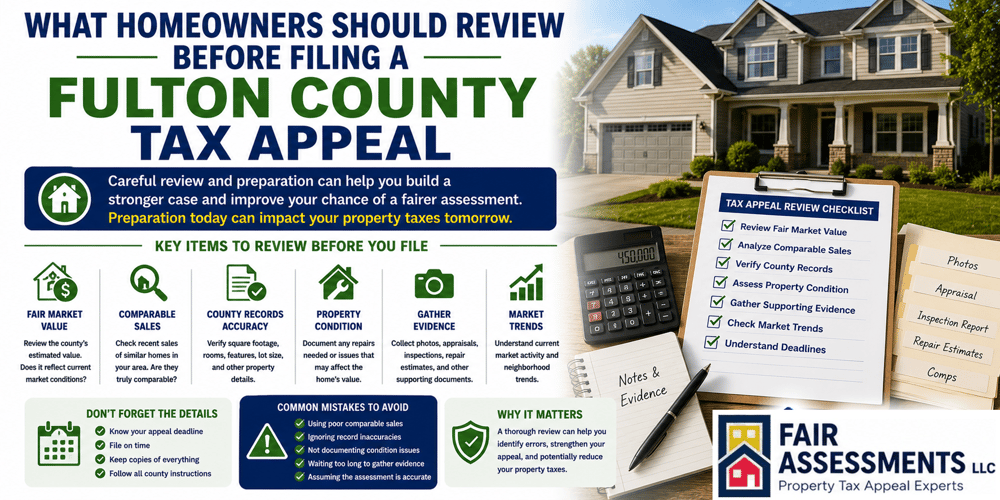
Why Preparation Matters
Property tax appeals are generally based on whether the county’s estimated fair market value accurately reflects current market conditions.
Before filing an appeal, homeowners may benefit from reviewing:
- Assessment notices
- Comparable sales
- County property records
- Property condition
- Market trends
- Supporting documentation
Careful preparation may help strengthen the overall appeal process.
Review the Fair Market Value
One of the most important steps is reviewing the county’s estimated fair market value.
Homeowners may want to ask:
- Does the value reflect current market conditions?
- Would the property realistically sell for that amount?
- Are nearby homes selling for less?
- Does the assessment appear unusually high compared to similar homes?
Understanding the county’s estimated value is often the starting point of an appeal review.
Review Comparable Sales
Comparable sales, often called “comps,” are commonly one of the most important parts of a property tax appeal.
Strong comparable sales are usually:
- Recently sold
- Located nearby
- Similar in size and layout
- Similar in condition
- Similar in age and features
Weak comparable sales may potentially lead to inflated assessments.
Verify County Property Records
County records may sometimes contain inaccuracies that affect property value calculations.
Homeowners may want to verify:
- Square footage
- Bedrooms and bathrooms
- Finished basements
- Garages and additions
- Lot size
- Property features
Even relatively small record errors may potentially increase assessments.
Review Property Condition
Property condition may significantly affect fair market value.
Homes with issues such as:
- Roof damage
- Structural concerns
- Water intrusion
- Deferred maintenance
- Outdated interiors
may not realistically sell for the same amount as fully renovated neighboring properties.
If condition problems are not reflected properly in the assessment, the estimated value may potentially appear too high.
Gather Supporting Evidence
Strong documentation may help support an appeal.
Useful evidence may include:
- Property photos
- Appraisals
- Inspection reports
- Contractor estimates
- Repair invoices
- Floor plans
- Surveys
- County record corrections
Organized evidence may help strengthen the overall appeal argument.
Review Recent Market Trends
Housing markets may shift quickly due to:
- Buyer demand
- Interest rates
- Housing inventory
- Economic conditions
- Neighborhood development
Understanding local market activity may help homeowners determine whether the assessment appears reasonable.
Understand Appeal Deadlines
Property tax appeal deadlines are extremely important.
Missing the filing deadline may limit the ability to challenge the assessment for that tax year.
Homeowners may benefit from:
- Opening assessment notices promptly
- Reviewing assessments early
- Gathering evidence as soon as possible
Early preparation may improve the overall appeal process.
Common Mistakes Homeowners Make
Some homeowners weaken their appeals by:
- Using poor comparable sales
- Ignoring county record inaccuracies
- Failing to document property condition
- Waiting too long to gather evidence
- Assuming assessments are automatically accurate
Careful review may help reduce these risks.
Why Professional Guidance May Help
Property valuation review and appeal preparation can sometimes become complicated.
Professional guidance may help homeowners:
- Analyze comparable sales
- Review assessment accuracy
- Identify county record discrepancies
- Organize supporting evidence
- Prepare stronger appeal support
This may improve the effectiveness of a property tax appeal.
Why Annual Assessment Reviews Matter
Property values and county records may change from year to year.
Annual review may help homeowners:
- Monitor assessment increases
- Catch county record errors
- Evaluate future appeal opportunities
- Reduce long-term overassessment risks
Regular monitoring may help homeowners stay informed about property tax changes.
Final Thoughts
Before filing a Fulton County tax appeal, homeowners should carefully review fair market value, comparable sales, county records, property condition, and supporting evidence.
By preparing thoroughly and identifying possible inaccuracies early, homeowners may improve their ability to challenge inaccurate assessments and potentially reduce unnecessary property tax costs.