
Many homeowners in Cobb County focus mainly on their property’s assessed value when reviewing tax notices, but one commonly overlooked issue is inaccurate county property records.
Even small errors in property records may affect how a home is valued and could potentially lead to higher property taxes over time.
Understanding how property record errors may impact assessments can help homeowners identify possible overvaluation concerns and determine whether a property tax appeal may be appropriate.
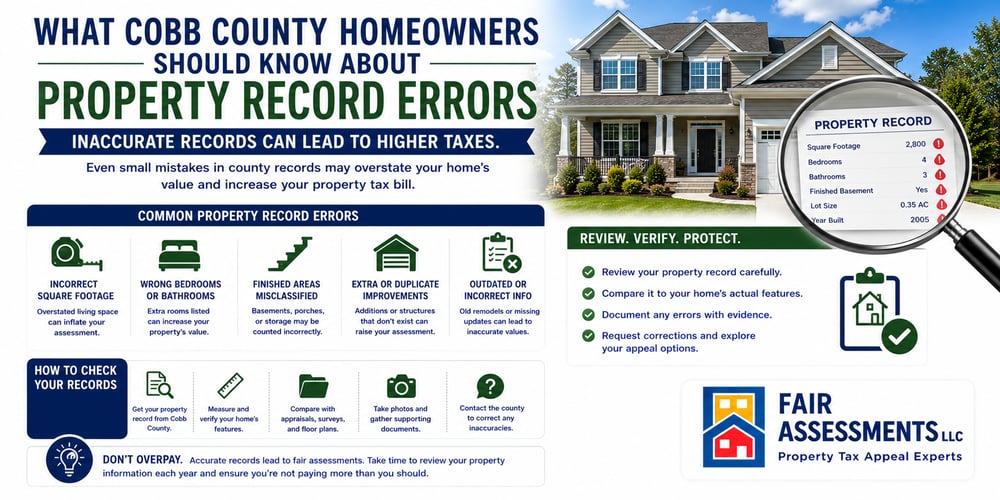
What Are Property Records?
County property records contain detailed information about a property that assessors use during the valuation process.
These records may include:
- Square footage
- Lot size
- Number of bedrooms and bathrooms
- Finished basements
- Garages and additions
- Property condition
- Renovation history
- Building features
Assessors often rely heavily on this information when estimating fair market value.
Why Property Record Accuracy Matters
If county records contain inaccurate information, the assessment itself may also become inaccurate.
Even relatively small mistakes may potentially affect:
- Fair market value estimates
- Assessed value calculations
- Property tax obligations
Reviewing property records carefully each year may help homeowners avoid long-term overassessment issues.
Common Property Record Errors
Some common inaccuracies homeowners may find include:
- Incorrect square footage
- Extra bedrooms or bathrooms listed
- Finished areas incorrectly counted
- Incorrect lot dimensions
- Duplicate improvements
- Structures that no longer exist
- Incorrect renovation information
These errors may potentially increase assessed value unnecessarily.
Why Square Footage Errors Are Important
Square footage is often one of the largest factors affecting property value.
If county records overstate:
- Finished living space
- Basement square footage
- Additions or expansions
the property may appear more valuable than it actually is.
Verifying measurements carefully may be important.
Problems With Finished Basements and Additions
County records sometimes incorrectly classify:
- Unfinished basements as finished
- Storage areas as living space
- Enclosed porches as heated square footage
- Non-permitted additions as full living areas
These classifications may increase estimated market value.
Why Property Condition Matters
County records may not always reflect condition problems accurately.
Important issues may include:
- Deferred maintenance
- Water damage
- Structural concerns
- Outdated interiors
- Needed repairs
If condition issues are missing from county records, assessments may not fully reflect the property’s actual market value.
How Homeowners Can Review Their Records
Homeowners may want to compare county records against:
- Appraisals
- Inspection reports
- Closing documents
- Property surveys
- Floor plans
- Actual property measurements
Careful comparison may help homeowners identify potential inaccuracies.
What If You Find an Error?
If homeowners discover incorrect information, they may consider:
- Requesting record corrections
- Gathering supporting documentation
- Providing photos or measurements
- Reviewing comparable sales
- Evaluating a possible property tax appeal
Correcting inaccurate records may potentially improve assessment accuracy.
Why Documentation Is Important
Strong documentation may help support correction requests and appeals.
Useful evidence may include:
- Property photos
- Contractor reports
- Surveys
- Floor plans
- Appraisals
- Inspection reports
- Repair estimates
Well-organized evidence may strengthen the overall case.
Can Property Record Errors Affect Comparable Sales?
Yes.
If county records incorrectly describe a property, the county may compare it to homes that are:
- Larger
- More updated
- Better maintained
- More valuable
This may lead to unfair comparisons and inflated assessments.
Why Professional Guidance May Help
Property record review and assessment analysis can sometimes become complicated.
Professional guidance may help homeowners:
- Identify record discrepancies
- Analyze comparable sales
- Evaluate market impact
- Prepare stronger appeal support
This may improve the effectiveness of a property tax appeal.
Final Thoughts
Property record errors in Cobb County may potentially lead to inflated assessments and higher property taxes if left uncorrected.
By reviewing county records carefully, verifying important details, and documenting inaccuracies thoroughly, homeowners may improve their ability to maintain fair and accurate property tax assessments.