
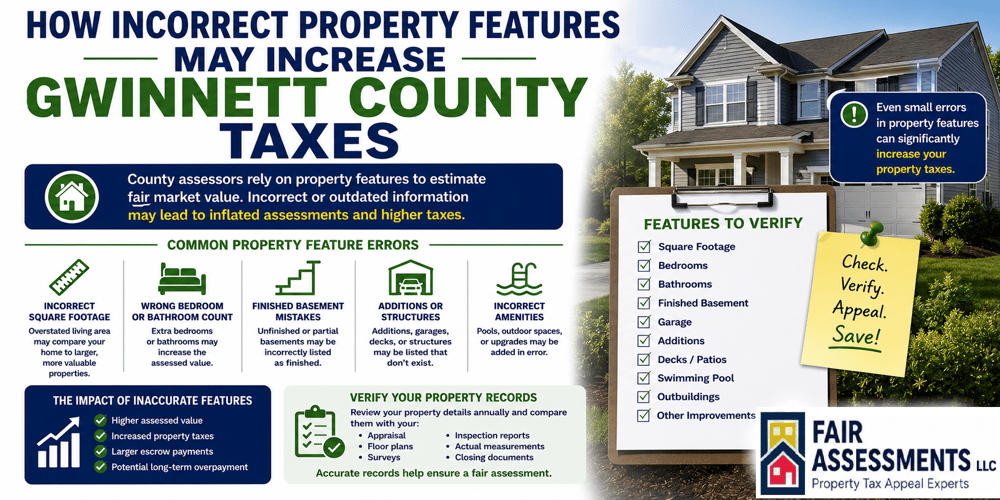
Incorrect property features in county records can significantly affect Gwinnett County property taxes because assessors often rely on those records when estimating fair market value.
Many homeowners are unaware that even small inaccuracies involving property details may potentially lead to inflated assessments and higher tax obligations. If county records incorrectly list features that add value to a home, the estimated property value may appear higher than it should.
Understanding how property feature errors affect assessments may help homeowners better review their assessment notices and determine whether a property tax appeal may be appropriate.
Why Property Features Matter
Property tax assessments are generally based on estimated fair market value.
County assessors commonly review property features when estimating:
- Fair market value
- Assessed value
- Taxable value
- Annual property tax obligations
Homes with additional or upgraded features may often sell for higher prices than similar homes without those features.
What Property Features Are Commonly Reviewed?
Gwinnett County property records may include details such as:
- Square footage
- Bedrooms and bathrooms
- Finished basements
- Garages
- Swimming pools
- Home additions
- Outdoor living spaces
- Detached structures
- Renovations and upgrades
These details help assessors estimate what buyers may realistically pay for the property under current market conditions.
How Incorrect Property Features May Affect Taxes
If county records incorrectly describe a property, the county may estimate a higher market value than appropriate.
This may potentially result in:
- Higher assessed value
- Increased property taxes
- Larger escrow payments
- Long-term overpayment
Even relatively small inaccuracies may affect property taxes over multiple years.
Common Property Feature Errors
Several common mistakes may appear in county records.
Incorrect Bedroom or Bathroom Counts
Records may incorrectly list extra bedrooms or bathrooms that do not exist.
Finished Basement Errors
County records may sometimes classify:
- Unfinished basements as finished
- Partial finished areas as fully finished
- Storage areas as living space
These inaccuracies may increase estimated property value unnecessarily.
Incorrect Square Footage
Overstated living area is one of the most common record issues.
If county records show more square footage than the property actually contains, the home may be compared to larger and more valuable properties.
Additions or Improvements That Do Not Exist
County records may occasionally include additions, garages, decks, or structures that were removed or never completed.
Duplicate Improvements
Some improvements may accidentally be counted more than once within property records.
How Property Feature Errors Affect Comparable Sales
Comparable sales, often called “comps,” are commonly used to estimate fair market value.
If county records incorrectly describe a property’s features, the county may compare the property to homes that are:
- Larger
- More updated
- Better equipped
- More valuable
This may potentially result in unfair comparisons and inflated assessments.
Why Property Condition Still Matters
Even if property features are accurate, condition issues may still affect market value.
Homes with concerns such as:
- Roof damage
- Structural problems
- Deferred maintenance
- Water intrusion
- Outdated interiors
may not realistically sell for the same amount as fully renovated neighboring homes.
Condition differences may significantly affect value comparisons.
How Homeowners Can Verify Property Features
Homeowners may want to compare county records against:
- Appraisals
- Floor plans
- Inspection reports
- Property surveys
- Closing documents
- Actual property measurements
Careful review may help identify discrepancies.
Why Annual Assessment Reviews Matter
County records and assessments may change over time.
Annual review may help homeowners:
- Catch property feature errors early
- Monitor assessment increases
- Verify county record accuracy
- Evaluate future appeal opportunities
Regular monitoring may help reduce long-term overassessment risks.
What Evidence May Help Correct Errors?
If homeowners discover inaccurate property features, useful evidence may include:
- Property photos
- Appraisals
- Floor plans
- Surveys
- Inspection reports
- Contractor measurements
Strong documentation may help support correction requests or property tax appeals.
Can Incorrect Property Features Be Appealed?
Yes.
Homeowners may often challenge inaccurate assessments caused by incorrect property features through the property tax appeal process.
Correcting inaccurate information may potentially lower the assessed value and reduce property taxes.
Common Mistakes Homeowners Make
Some homeowners weaken their review process by:
- Assuming county records are automatically correct
- Ignoring finished basement classifications
- Failing to verify square footage
- Waiting too long to review assessments
Careful annual review may help reduce these risks.
Why Professional Guidance May Help
Property record review and assessment analysis can sometimes become complicated.
Professional guidance may help homeowners:
- Identify record discrepancies
- Analyze comparable sales
- Review assessment accuracy
- Organize supporting evidence
- Prepare stronger appeal support
This may improve the effectiveness of a property tax appeal.
Final Thoughts
Incorrect property features may significantly increase Gwinnett County taxes because assessors often rely heavily on county records when estimating fair market value.
By reviewing county records carefully, verifying important property details annually, and responding quickly to possible inaccuracies, homeowners may improve their ability to maintain fair and accurate property tax assessments while potentially reducing unnecessary property tax costs.