
Deferred maintenance can play an important role in DeKalb County property values and property tax assessments. While many homeowners focus on neighborhood sales and market trends, the actual condition of a property may also significantly affect what buyers are willing to pay.
When maintenance issues are not fully reflected in a property assessment, homeowners may potentially face inflated property values and higher property taxes.
Understanding how deferred maintenance affects market value may help homeowners better review their assessments and determine whether a property tax appeal may be appropriate.
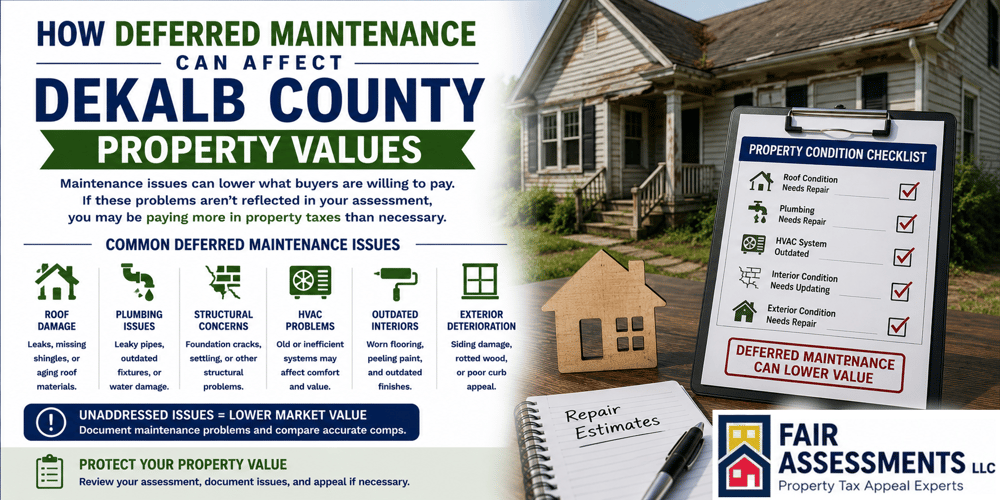
What Is Deferred Maintenance?
Deferred maintenance refers to repairs or upkeep that have been delayed over time.
This may include issues such as:
- Aging roofs
- Damaged flooring
- Outdated plumbing
- HVAC problems
- Water damage
- Exterior deterioration
- Structural concerns
- Peeling paint or worn finishes
Over time, these issues may reduce the property’s overall market value.
Why Deferred Maintenance Matters
Property tax assessments are generally based on estimated fair market value.
Homes with significant maintenance issues may not realistically sell for the same amount as fully updated neighboring properties.
Deferred maintenance may potentially affect:
- Fair market value
- Assessed value
- Taxable value
- Annual property taxes
How DeKalb County Estimates Property Value
DeKalb County assessors commonly consider factors such as:
- Comparable sales
- Property size
- Neighborhood trends
- Home features and upgrades
- Property condition
- Market activity
However, county records and assessments may not always fully reflect deferred maintenance issues inside the property.
Why Property Condition Is Important
Two homes in the same neighborhood may still differ significantly in value based on condition.
Examples of condition-related differences may include:
- Roof age
- Foundation problems
- Water intrusion
- Structural damage
- Outdated interiors
- Needed repairs
A buyer may pay substantially less for a home requiring major repairs compared to a fully renovated property nearby.
How Deferred Maintenance Affects Comparable Sales
Comparable sales, often called “comps,” are commonly used to estimate fair market value.
If the county compares a home with deferred maintenance to fully updated neighboring homes, the estimated assessment may potentially appear too high.
Strong comparable properties are usually:
- Recently sold
- Located nearby
- Similar in size and style
- Similar in condition
Condition differences may significantly affect whether a comparable sale is truly accurate.
Can County Records Miss Maintenance Problems?
Yes.
County records may not always reflect:
- Interior damage
- Water intrusion
- Structural concerns
- Aging systems
- Cosmetic deterioration
- Deferred maintenance issues
If these problems are not documented properly, the county may estimate a higher value than the property would realistically sell for.
What Evidence May Help Document Deferred Maintenance?
If homeowners believe maintenance issues were overlooked, useful evidence may include:
- Property photos
- Inspection reports
- Contractor estimates
- Repair invoices
- Appraisals
- Engineering reports
Strong documentation may help support a more accurate valuation argument.
Why Repair Estimates Matter
Repair estimates may help demonstrate how maintenance issues affect market value.
Examples may include estimates for:
- Roof replacement
- Foundation repairs
- HVAC replacement
- Water damage restoration
- Plumbing repairs
- Structural repairs
These costs may influence what buyers would realistically pay for the property.
Why Annual Assessment Reviews Matter
Property condition and market conditions may change over time.
Annual review may help homeowners:
- Monitor assessment increases
- Document worsening condition issues
- Catch county record inaccuracies
- Evaluate future appeal opportunities
Regular review may help reduce long-term overassessment risks.
Common Mistakes Homeowners Make
Some homeowners weaken their appeals by:
- Failing to document maintenance issues
- Using weak comparable sales
- Ignoring county record errors
- Waiting too long to gather evidence
- Assuming assessors already know about interior problems
Clear and organized evidence may strengthen the overall appeal process.
Can Deferred Maintenance Support a Property Tax Appeal?
Yes.
If homeowners believe deferred maintenance was not properly reflected in the county’s assessment, they may have the right to file a property tax appeal.
Supporting evidence may help demonstrate that the estimated fair market value appears too high based on the property’s actual condition.
Why Professional Guidance May Help
Property condition analysis and assessment review can sometimes become complicated.
Professional guidance may help homeowners:
- Analyze comparable sales
- Evaluate condition adjustments
- Review assessment accuracy
- Organize supporting evidence
- Prepare stronger appeal support
This may improve the effectiveness of a property tax appeal.
Final Thoughts
Deferred maintenance can significantly affect DeKalb County property values because property condition directly influences what buyers may realistically pay in the market.
By reviewing assessments carefully, documenting maintenance concerns thoroughly, and comparing the property against accurate comparable sales, homeowners may improve their ability to identify inaccurate valuations and potentially reduce unnecessary property tax costs.