
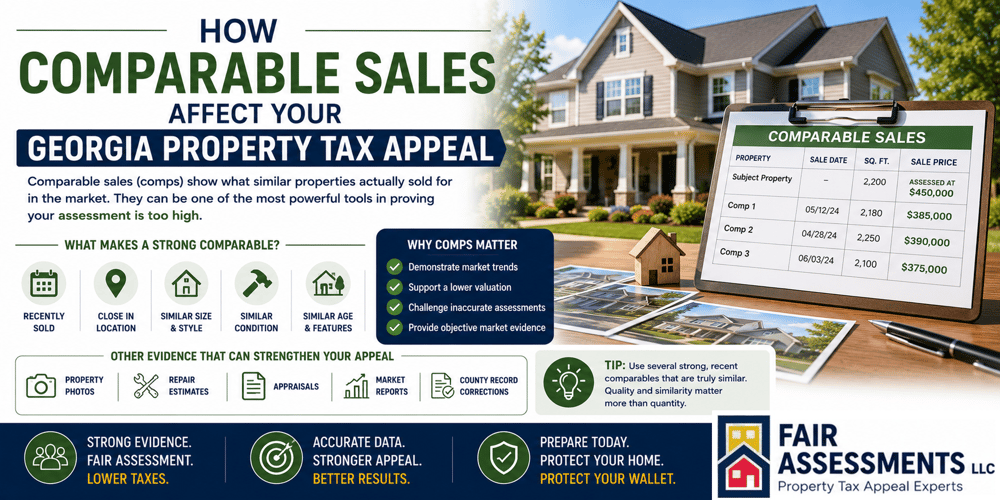
When homeowners file a property tax appeal in Georgia, one of the most important pieces of evidence is often comparable sales, commonly called “comps.”
Comparable sales can help show whether a property’s assessed value accurately reflects current market conditions. Understanding how comps work may help homeowners build a stronger property tax appeal.
What Are Comparable Sales?
Comparable sales are recently sold properties that are similar to the subject property.
These properties are typically compared based on factors such as:
- Location
- Size
- Age
- Condition
- Lot size
- Features and upgrades
- Property type
The goal is to determine what similar homes are actually selling for in the current market.
Why Comparable Sales Matter
County assessors often use market sales data when estimating fair market value.
If nearby comparable homes recently sold for less than the county’s assessed value, that information may support an argument that the assessment is too high.
Strong comparable sales may help:
- Demonstrate market trends
- Support a lower valuation
- Challenge inaccurate assessments
- Provide objective market evidence
What Makes a Strong Comparable Sale?
Not every nearby property makes a good comparison.
The most effective comparable sales are usually:
- Recently sold
- Located close to the property
- Similar in size and style
- Similar in condition
- Similar in age and features
The more similar the property, the stronger the comparison may be.
Why Timing Matters
Real estate markets can change quickly.
Older sales may not accurately reflect current market conditions, especially in areas experiencing:
- Rapid appreciation
- Declining values
- Seasonal market shifts
- Neighborhood changes
Recent sales are generally more useful in supporting current valuation arguments.
Differences That Can Affect Comparisons
Even homes in the same neighborhood may have major differences that impact value.
Factors that may affect comparisons include:
- Renovations
- Pools
- Finished basements
- Additional square footage
- Waterfront or premium lots
- Property condition
- Garages or outbuildings
Adjustments may sometimes be necessary when comparing properties with different features.
Can County Comparisons Be Incorrect?
In some situations, county assessments may rely on sales that are not truly comparable.
Possible issues may include:
- Comparing dissimilar properties
- Using outdated sales data
- Overlooking property condition issues
- Ignoring local market factors
Reviewing the county’s valuation approach carefully may help identify weaknesses in the assessment.
Where Can Homeowners Find Comparable Sales?
Comparable sales information may be available through:
- Public property records
- Real estate websites
- County databases
- MLS data
- Appraisers or real estate professionals
Accurate sales data is important when preparing a property tax appeal.
How Many Comparable Sales Should Be Used?
There is no exact number required, but many appeals rely on several strong comparable sales rather than a large quantity of weaker comparisons.
Quality and similarity are usually more important than volume.
Additional Evidence That May Help
Comparable sales are often strongest when combined with other supporting evidence such as:
- Property photos
- Repair estimates
- Appraisals
- Market reports
- County record corrections
A well-rounded appeal package may provide stronger overall support.
Why Professional Guidance May Help
Selecting strong comparable sales can sometimes be more complicated than it appears.
Professional guidance may help homeowners:
- Identify stronger comparables
- Analyze market data
- Adjust for property differences
- Build more effective appeal evidence
This may improve the overall strength of a property tax appeal.
Final Thoughts
Comparable sales play a major role in many Georgia property tax appeals because they help demonstrate how a property’s assessed value compares to actual market activity.
By reviewing recent sales carefully, selecting strong comparisons, and understanding local market conditions, homeowners may improve their ability to challenge inaccurate property assessments and potentially lower their property taxes.